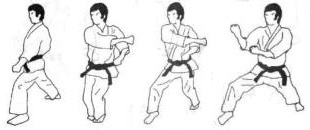
Heian means "Peaceful Mind". This word is the first of five said the base rate, which was created by Yasutsune Itosu (one teacher Gichin Funakoshi). Although it is not known how the Heian Kata was created, but many argue that the word Heian is part of a higher order, namely Kata Kanku-Dai. Itosu creating Karate Kata Heian to introduce into the school curriculum to eliminate the impression dangerous techniques contained in advanced word. Heian Kata is Kata Shorin, who demonstrate the power and flexibility of movement.
Important thing :
Punch fore attitude and forward motion. Has 21 movements with the application time of 40 seconds.
Kata means literally "shape" or "model." Kata is a formalized sequence of movements which represent various offensive and defensive postures. These postures are based on idealized combat applications. The applications when applied in a demonstration with real opponents is referred to as a Bunkai. The Bunkai shows how every stance and movement is used. Bunkai is a useful tool to understand a kata.
Kata used for testing in test hikes belt, to familiarize themselves in motion, to make it easier to memorize the movement, and others.
do not worry and feel lazy to know or learn Kata. because you are not required to memorize or do everything. you just need to learn some of the main Kata are commonly in use in the level kyu or beginners. and the rest for Dan or existing levels of black belt.
In learning kata you must lear one by one and do not need to be memorized with difficulty just need to follow the movement many times in order to get used to and memorize.
You can forget about Kata before and remember next kata if you just want to know, but if you do that you will not be familiar with the basic movements and will reduce the rate of movement provisions in the next Kato.
So, should you do Kata you've learned before one in every meeting after stretching and kihon (after do video at Kihon Shotokan Style : learning karate at home 1.1). If you forget, you can see the video again. but do not be too memorize it again did just continue until you get used to and by itself will remember indirectly. use your memory to memorize the next Kato.
When we are in a state of defense attacked obviously very necessary because without fending certainly punches or kicks the opponent will land with a landslide into our bodies. Unlike a kick or punch, the defense of our body position should be sideways or in line with the stance it is intended that when a punch or a kick miss of defense we are not on our bodies.
Here are the names of defense in Karate.
1. Gedan Barai : Parry below or parry Mae-Geri.
2. Soto-Ude-Uke : Parry middle coming from behind the ear.
3. Ude Uchi-Uke : Parry middle coming from below armpit.
4. Agi-Uke : Parry top
5. Shuto-Uke : Parry handed sword
6. Juji-Uke : Parry with both hands crossed
7. Morote-Uke: Parry shaped like Morote-Zuki
In each lesson you just need to have a video that I have previously posted on Kihon Shotokan Style : Learning Karate At Home (1.1). Make a video that every time you start training karate. You do not need to have a video as described above in each meeting. Video and this article only to find out the details of the three major stance and know some of the existing stance.
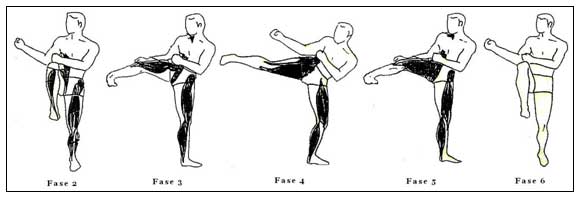
In addition to attacking the opponent with a blow (Zuki) in Karate can also use the kick (Geri) with a wide and diverse forms according to the needs and situations faced. Geri is generally used in a fight at a distance that is not too tight.
Here are the types of Geri in Karate :
1. Mae-Geri : Kick toward the stomach or the head of the forward direction
2. Mawashi-Geri : Kick the upper leg
3. Yoko-Geri-Kekome : Kick to the leg side (in spade)
4. Yoko-Geri-Keange : Kick to the leg side (on the snap)
5. Usiro-Geri : Kick to the back
In each lesson you just need to have a video that I have previously posted on Kihon Shotokan Style : Learning Karate At Home (1.1). Make a video that every time you start training karate. You do not need to have a video as described above in each meeting. Video and this article only to find out the details of the three major stance and know some of the existing stance.
Punch (Zuki) is a movement that is not less important to the stance, because the blow is we need to attack the opponent besides Geri or kick. Here are a variety of punches (Zuki) in Karate.
1. Oi-Zuki-CHUDAN : Blow toward stomach or heartburn
2. Jodan Oi-Zuki : A blow to the head
3. Kisame-Zuki : A blow to the head but did not step foot
4. Gyaku-Zuki : A blow to the stomach, but the foot did not step
5. Ura-Zuki : Blow that looks like Soto-Ude-Uke
6. Morote-Zuki : Punch and encouragement
7. Agi-Zuki : Blow by hand inside and shaped like Agi-Uke
8. Choku-Zuki : Blow towards the stomach with Hachiji-Dachi stance
9. Kage-Zuki : Punches aside EXS on Tekki Kata Shodan
10. Tate-Zuki : Blow that looks like Uchi-Ude-Uke
11. Yama-Zuki : Blow mounting / double blow with both hands
12. Morote-Hisame-Zuki : Punch with both hands
13. Tetsui-Uchi : Hand hammer
14. Uraken-Uchi : Blow sideways
15. Haishu-Uchi : Hand sword
16. Haito-Uchi : Hand sword
17. EMPI : dig (elbow)
18. Shuto-Uchi : Hand sword
19. Tate-Shuto : Hand sword
In each lesson you just need to have a video that I have previously posted on Kihon Shotokan Style : Learning Karate At Home (1.1). Make a video that every time you start training karate. You do not need to have a video as described above in each meeting. Video and this article only to find out the details of the three major stance and know some of the existing stance.
6. Heisoku-Dachi : stance amid heavy but both feet together
7. Neko-Ashi-Dachi : rear weight stance
8. Sanshin-Dachi : middle weight stance
9. Sochin-Dachi : middle weight stance
It is the main stances frequently used (it only partially because there are many more stances).
If you bother to learn all, you can not learn them all directly. See the video below, This is a detailed video about the stance that must be known. There are three stance that must be known Zenkutsu-Dachi, Kokutsu-Dachi and Kiba-Dachi. For the rest you can learn indirectly if you learn Kata.
In each lesson you just need to have a video that I have previously posted on Kihon Shotokan Style : Learning karate at home (1.1) Make a video that every time you start training karate. You do not need to have a video as described above in each meeting. Video and this article only to find out the details of the three major stance and know some of the existing stance.
Kihon is karate styles place varying importance on kihon. Typically this is performance in unison of a technique or a combination of techniques by a group of karateka. Kihon may also be prearranged drills in smaller groups or in pairs. Or we can be said kihon is the basic of all movements.
Select one for see how to movements in kihon (only if you want know more detail from every movements).
Watch Video for see how to movements in kihon (with stretching and movements but not all movements just major movements / it's training kihon if you join in some club).
Kihon like the video above is not to be repeated only once in every meeting and must be performing and in first, even for those who have advanced karate. do not be surprised if different stretching above the stretch in other places because in some places it is added or replaced some movement depending on the area and Sempai or Sensei or Renshi / Dai Sense or Shihan / Hansi (teacher) respectively After performing kihon movements like the video above you can continue to learn Kata.